How mobile habits form
The four-step cue, craving, action, reward loop, and why phones build habits faster than almost anything else.
An age-wise, practical plan for managing screen time, handling resistance calmly, and building screen-free routines your whole family can keep.
If you recognise some of these, you're not alone, and you haven't failed as a parent. Apps are built by large teams to be hard to put down, even for adults.
Meals only happen with a cartoon playing. Without the phone, the plate stays full.
Screen time ending turns into an argument, or tears, every single day.
Bedtime keeps getting later because of "one more video" or one more game.
"I'm bored" is the first thing you hear the moment the screen goes off.
You're unsure which rules are realistic for your child's age, and what's actually worth watching.
Different adults, different rules. One says no, someone else hands over the phone.
Simply taking the phone away rarely works for long. The habit, the triggers and the routine around the phone are still there. What helps is understanding why it happens, and changing things step by step.
A practical guide that explains why screen habits form and why children struggle to stop, then walks you through building healthier routines at home.
The goal is not zero screens. Screens are part of school, family video calls and creativity. The goal is balance: your child using the phone as a tool, not the other way round.
Each chapter is short, practical and written for busy parents.
The four-step cue, craving, action, reward loop, and why phones build habits faster than almost anything else.
Eight common reasons, from boredom and FOMO to "just one more level", so you can respond with empathy instead of anger.
15 honest questions with a simple scoring guide to see where your family stands today.
What works for a toddler, a preschooler, a school-age child and a teenager, side by side with expert guidelines.
A step-by-step plan to reduce screen time gradually while building new habits to replace it.
What to say before screen time ends, during a meltdown, and when negotiating with older children and teens.
A green-yellow-red content guide, a 6-question test for any show or app, and ideas for good content by age.
Built-in free tools like Google Family Link and Apple Screen Time, plus simple settings that reduce the pull.
Practical answers for "won't eat without a cartoon", grandparents and the phone, homework on devices, late-night teens and more.
Gradual, structured and realistic. Adjust the pace to your child, but don't skip steps.
This is a structured approach, not a promise that every child changes in four weeks. The book is honest that the first days are usually the hardest and that real habits take time; it shows you how to stay calm and consistent through that phase.
Digital PDF · 15 chapters + references
Not just reading. The book includes ready-to-use tools to put the plan into practice.
These are real pages from the eBook. Tap any page to enlarge it.
The book compares guidance from the WHO, the Indian Academy of Pediatrics and the American Academy of Pediatrics, then turns it into practical steps for each stage.
This is general educational guidance. If you have concerns about your child's development, health or behaviour, please talk to a paediatrician or a qualified professional.
A full list of 60 ideas, grouped so you can quickly pick something for the time and space you have. A few examples:
Stick it on the fridge. When your child says "I'm bored", point to the list. The book also explains why a little boredom is healthy, and when it's fine to let them figure it out.
Digital PDF eBook · 31 pages · Edition 2026 · Not a printed book
After successful payment, you're taken to the download page for the PDF.
The book draws on published studies and guidance, listed in a references section at the end. It cites, among others:
These organisations are cited as sources only; they have not reviewed, endorsed or approved this eBook. The book is for general educational purposes and is not medical, psychological or legal advice.
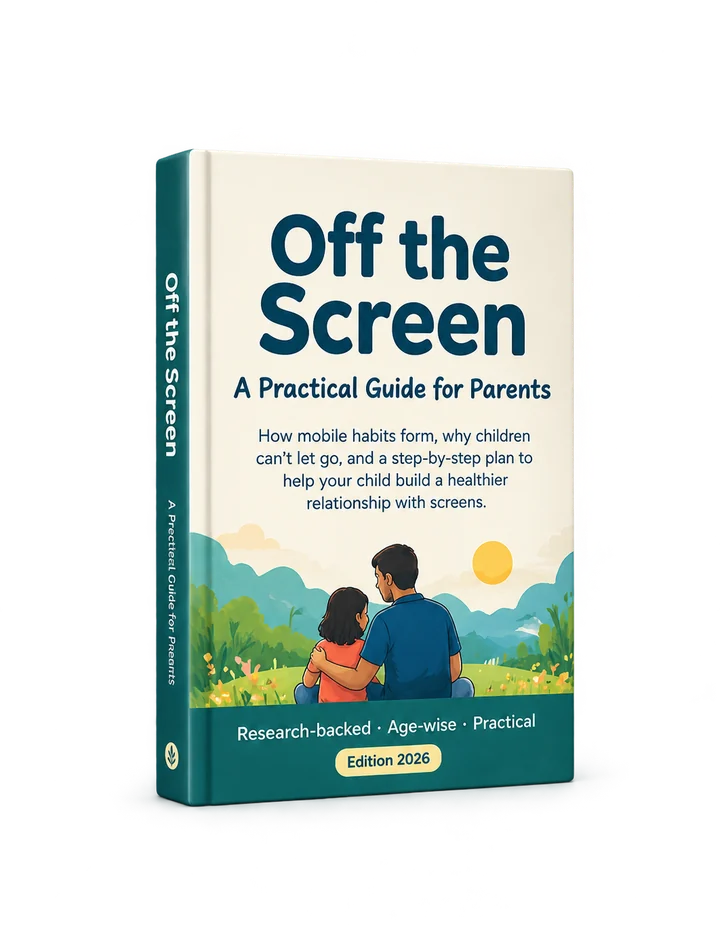
A practical eBook for parents that explains how screen habits form and why children struggle to stop, then gives a step-by-step plan, scripts, age-wise strategies and screen-free activities to help build healthier routines at home.
A digital PDF (31 pages) that opens on any phone, tablet or computer. It is not a printed book.
15 chapters: the current research, how mobile habits form, why children can't let go, a self-check, expert recommendations by age, the parent mindset, the 4-week reset plan, handling tantrums, age-wise strategies, choosing good content, 60 screen-free activities, parental-control tools, real-life situations, when to seek professional help, and a family media agreement with trackers.
Yes. There is a dedicated section for ages 13–18, and a part on negotiating with older children and teens rather than dictating rules.
Yes, that's who the reset plan is designed for. It reduces screen time gradually and helps you handle the resistance that usually comes in the first days. The self-check also helps you judge when to involve a professional.
It is laid out over four weeks, but you can adjust the pace to your child. The book is clear that lasting habits take time and that progress matters more than perfection.
No. Every child and family is different, and no book can guarantee a result. What it gives you is a clear, structured approach and practical tools; results depend on your situation and on consistency.
No. It is general educational information. For concerns about your child's health, development or behaviour, please consult a paediatrician or a qualified mental-health professional. Chapter 14 lists warning signs and helplines in India.
After your payment is completed, the payment page redirects you to a download page with a button to open the PDF. Please bookmark that page or save the PDF to your device.
Please contact us with your payment ID and we'll help you get access.
A structured plan, calm scripts for the hard moments, and 60 ideas to fill the time you win back.
Download page opens after successful payment