E-commerce & Claude — The Real Basics
The seven jobs of a store, how Claude differs from a chatbot, and what MCP actually is.
A practical operator's manual for using Claude AI across product research, unit economics, store optimization, Meta Ads, COD logistics, RTO management and everyday e-commerce operations.
Digital PDF · Instant access after successful purchase and redirect
The book's first chapter puts it plainly: running a store is seven jobs stitched together, and a weakness in any one of them quietly kills the other six. In Indian COD, an order is not a sale. It is a promise.
This manual gives you a structured way to approach each of these areas with Claude. The decisions and the work are still yours.
CLAUDE X ECOM is not a collection of generic AI tips. Every chapter gives you three things: what to understand, what to do, and the exact prompt to paste into Claude. It is built around workflows, calculations and operating decisions.
Each chapter explains the concept first: what MCP is, what CPP really measures, why RTO is six leaks, not one.
Copy the prompt as printed. Fill the [SQUARE BRACKETS] with your product, price or campaign ID.
Connect Shopify, Meta Ads and your shipping panel so Claude reads real numbers, not remembered ones.
Check the answer against your dashboards, then make the call. Anything that spends money waits for your yes.
Claude's usefulness depends on the tools, integrations and permissions you set up, and on the accuracy of the business information you give it. The book says so itself: "Claude is an operator, not an oracle."
The seven jobs of a store, how Claude differs from a chatbot, and what MCP actually is.
The 30-minute foundation: a store Project, a Business Brief and seven keyword shortcuts.
Shopify, Meta Ads, shipping panels and Gmail, step by step, with a troubleshooting table.
Realised revenue, cost per order, break-even CPP and target CPP, worked through with real COD maths.
A six-step validation ladder, from competitor ads to a final GO / NO-GO with a quit number.
Four sourcing routes, true landed cost, negotiation prep, sample scorecards and reorder timing.
The eleven page blocks in order, page audits, checkout fixes and prepaid nudge copy.
Anatomy of a converting video, ten hook frameworks and a 7-day creative testing plan.
A simple account structure, account reviews, scaling schedules and written kill rules.
Ranking couriers by true cost per delivered order, weight disputes and packaging.
The six-layer prevention funnel, from targeting to NDR recovery, with prompts for each layer.
A 7-message WhatsApp journey, review requests, angry-customer replies and repeat buyers.
The COD cash cycle, a 45-day cash model, a delivered-orders P&L and monthly reconciliation.
One "report all" command, section shortcuts, a 35-minute daily rhythm and the monthly close.
What to automate first, the overnight RTO guard, an ad-rule watchdog, and what never to automate.
Each mistake with its fix and the chapter that covers it, plus a self-audit prompt.
Calculators, copy, analysis prompts and plain definitions of AOV, CPP, NDR, RTO and more.
Everything in the book, sequenced day by day across four weeks.
Recommended reading order: Starting from zero? Read Chapters 1 to 4 in order. Already running a store? Go straight to Chapter 4, then Chapter 11 (RTO) and Chapter 9 (Ads).
Every prompt is written to be copied exactly as printed, with editable placeholders. Each one comes with two helpers:
[BRACKETS]Blanks you fill with your own product, price, campaign ID or pincodeSHORTA one-line version for when you are on your phoneWHAT HAPPENSWhat Claude does behind the scenes, so you know whether to trust the answer as-is or check it twiceThe book's worked example. Push CPP past ₹301 while scaling and every extra order loses money, while the dashboard still looks healthy.
Taken directly from the PDF. Tap a page to enlarge it.
5 of the 65 pages in the PDF.
The PDF ends with a day-by-day plan that sequences everything in the book. Already running a store? The book says to skip to Week 2 and use Week 1 as an audit checklist.
The plan is a sequence, not a promise. It does not guarantee that a store will launch successfully or become profitable in 30 days.
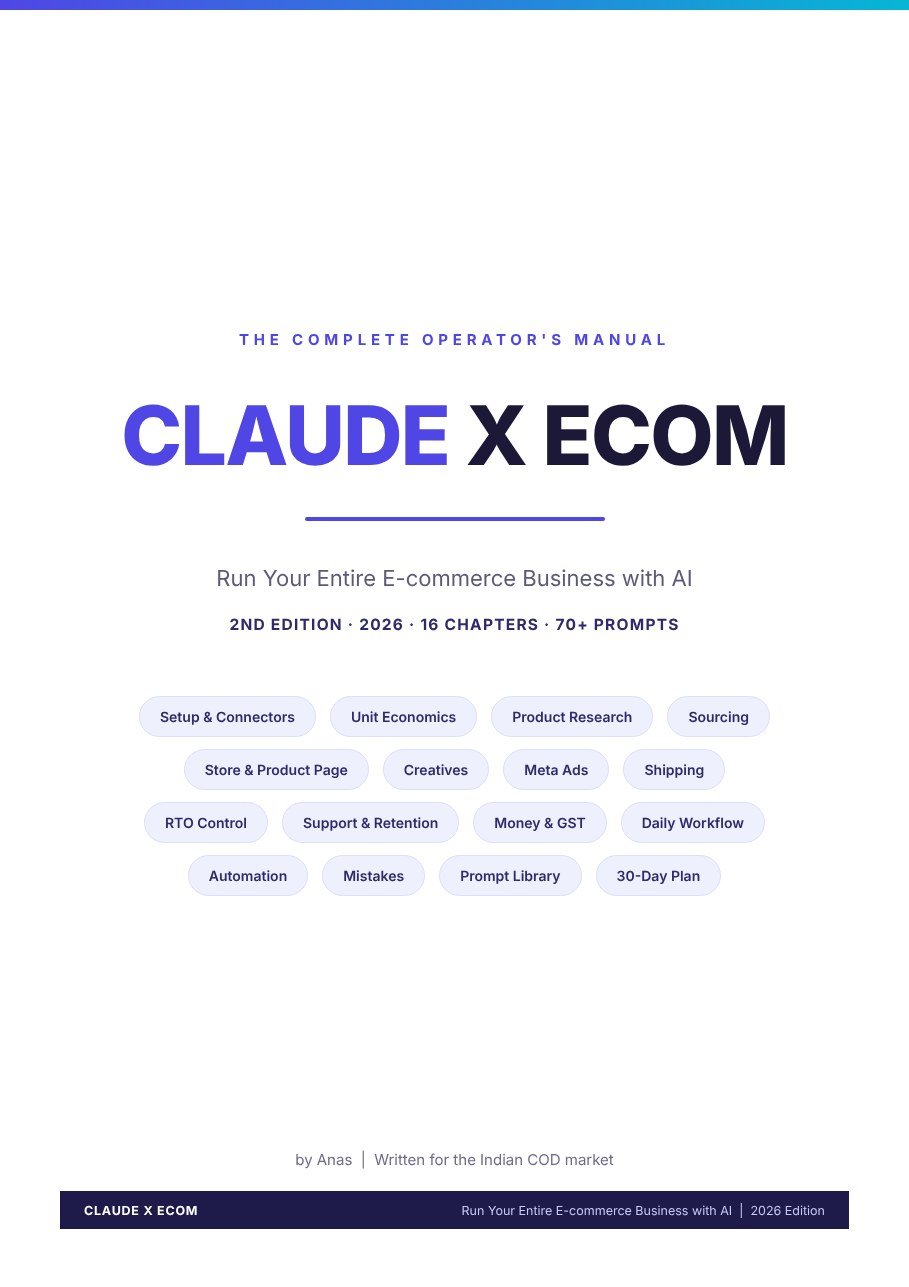
The CLAUDE X ECOM 2026 Edition as a single PDF: 16 chapters, the Prompt Library & Glossary, and the 30-Day Launch Plan (65 pages).
Digital only. Nothing is shipped. You download the PDF and read it on your phone, tablet or computer.
Yes. The book has a path for people starting from zero: read Chapters 1 to 4 in order, then 5 to 9, launch, and use 10 to 16 as reference. Terms like CPP, RTO and NDR are explained, and there is a glossary.
The book is written around Shopify, Meta Ads and a shipping panel. It lists "a Shopify store, or the intention to open one" as a requirement, so you can read it before your store exists. The connection chapters assume you will be on Shopify.
Not to start. According to the book, the free tier is enough to learn, write copy and test prompts, and a paid plan becomes realistic once Claude runs your daily operations. You will also need a laptop or desktop for setup; the phone app alone is not enough to connect tools.
No. The book's own rule is "machine watches, machine recommends, human approves." Claude can read data, analyse and draft. Anything that spends money, messages a customer or cannot be undone should wait for your confirmation.
No. It is an operations manual. Benchmarks in the book are estimates from Indian COD ranges and will vary by category, price and season. Results depend on your product, your execution and the market.
Yes, that is its focus. It covers COD economics, RTO (with a full chapter), NDR handling, couriers like Shiprocket and Delhivery, COD remittance cycles and GST orientation. GST content is orientation, not professional advice.
Your purchase includes the 2026 Edition PDF. Future editions are not promised as part of this purchase.
Explore the prompts, frameworks and operating processes inside CLAUDE X ECOM — 2026 Edition.
This is a digital PDF. Business outcomes depend on your implementation, market conditions and your own decisions.